
What are Waterproofing methods?

Rubbergard
EPDM*
- Weather Resistant
- Fire Resistant
- Easy to apply
What are waterproofing methods
It is a well-known fact that long-term exposure to water or moisture can destroy a structure. Now there are various types of waterproofing, but the goal of each type is the same, i.e., to form a barrier against moisture and liquid. Waterproofing methods may be used in various parts of the building, like on the surface of the foundation, on the structural elements of the building, walls and roofs to prevent the ingress of water via these surfaces.
Broadly speaking, the most common types of waterproofing materials used are cementitious materials, liquid waterproofing membranes, bituminous materials, polyurethane liquid waterproofing membranes and others.
The most important parts of the building or structure that require waterproofing are the basement of the structure, kitchen, walls, balconies, bathrooms, roofs, terraces, water tanks, green roofs, and swimming pools, in addition to other parts of the building.

Types of Waterproofing Methods
As mentioned earlier, the five most common types of waterproofing methods are:
- Single Ply Membrane
- Bituminous membrane
- Liquid waterproofing membrane
- Polyurethane liquid membrane
- Bituminous membrane
- Bituminous coating
We will briefly run through each type of material and coating in the next section. However, feel free to contact us if you need waterproofing for your building. We will use the right type for your structure.
Single Ply Membrane
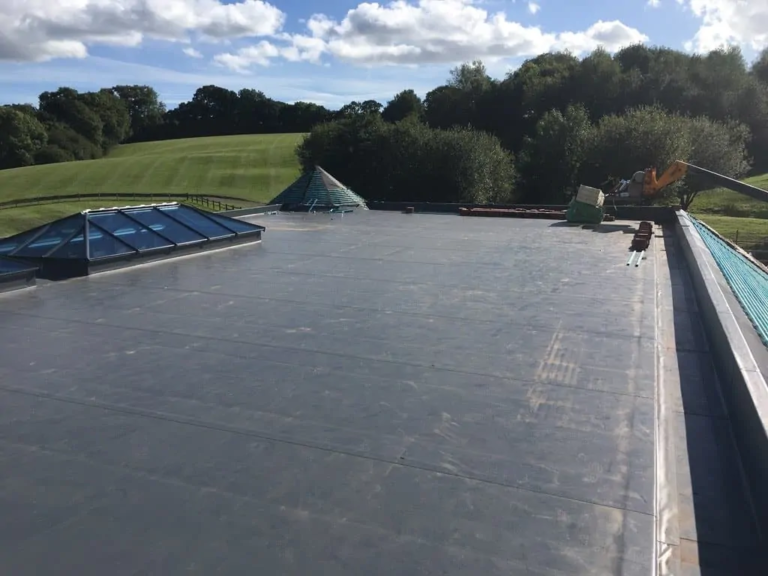
The beauty of a single-ply membrane is that it is easy to apply, lightweight and cost-effective. Most of all it lasts nearly forever, ensuring that homeowners save money by not having to get it reapplied every few years. It is also ideally suited for the most popular flat roofing systems, especially for projects where the additional load isn’t an option. Plus, the membrane is durable so that it can withstand the rigors of the South African climate, including tears, punctures and other issues.
Cementitious Waterproofing
By far, this is the easiest of all waterproofing methods, but it can only be used when the building is being constructed. Most construction supply or masonry supply companies have materials to serve cementitious waterproofing needs. All that’s needed is to mix the products up correctly and apply them.
Cementitious waterproofing is often used in the internal walls of wet or highly moist areas, like the toilet. The content is either rigid, or it may be a semi-flexible type of substance, but perfect for bathrooms where there is no sunlight but lots of moisture. That’s why the material does not need to go through a constant contraction and expansion process like other materials applied externally would have to undergo.
Where is cementitious waterproofing used?
Cementitious waterproofing is used in the following types of structures:
● Tunnels
● Bridges
● Parking structures or parking lots
● Sewage treatment projects
● Dams
● Marine cargo areas or docks
● Concrete dykes or river locks
Liquid Waterproofing Method
Usually, the product is a thin coating mainly consisting of a primer or the base coat, followed by two topcoats, which are either sprayed on or a roller is used to apply. Some professionals may also use a trowel. The perk of using the liquid waterproofing method is that it’s much more flexible than cementitious waterproofing.
After application, the liquid will cure into a thick rubbery substance that sticks to the surface. The substance can be elongated, reaching as high as 280% of its original size. However, the precise durability of the resulting coat mainly depends on the polymer used and how the manufacturer has meant it to be.
The liquid waterproofing membrane is easily sprayed on and comprises polymer-modified asphalt. Then there are polyurethane liquid membranes for various grades of roller, trowel, and spray applications available from multiple manufacturers or brands.

Get in touch
Waterproof Lab EPDM Rubber Waterproofing
Company Details
- Waterproof Lab EPDM Rubber Waterproofing
- The Siding Business Park, Unit 12, 22 Plantation Rd, Ottery, Cape Town, 7708
- 087 012 5339
- info@waterprooflab.co.za
Rubbergard
EPDM*
- Light weight
- No maintenance
- Eco Friendly
The Bituminous Coating
It is a type of coating that’s flexible and used for waterproofing. It works by forming a protective coat based on its formulation and grade of polymerization. The coating provides adequate protection against water, but its effectiveness is mainly based on the quality of the polymer used and the reinforced fiber.
Most people refer to the bituminous coating as asphalt coating. The most common application is used in areas underneath the wet screed. The surface protection and waterproofing agent work well on concrete surfaces, which makes it worth considering on concrete foundations.
As the term implies, Bituminous coatings are primarily made from bitumen-based materials, so they shouldn’t be exposed to sunlight. When exposed to sunlight, the layer can become brittle and thus easily breakable unless it is further modified using additional flexible material like acrylic-based polymers or polyurethane.
The overall flexibility of the finished product mainly depends on how solid the polymer’s content is mixed into the primary bitumen content.
Bituminous Membrane Waterproofing
Bituminous membrane waterproofing has, over the years, become increasingly popular in many parts of the world with low-sloped roofs, owing to its comparatively better performance. The membrane is also available as a torch on the membrane, as there is also §a self-adhesive version of it.
The self-adhesive compounds include polymers, asphalt, filler, resins and oils, which improve the ability of the membrane to adhere. However, the self-adhesive version of the membrane has a comparatively low shelf life since the bonding properties tend to reduce with time.
There are two types of torch on membrane, i.e. the covered and exposed types. Exposed membranes are made from granular mineral aggregate, capable of withstanding wear and tear. The other type requires the contractor to apply a protective screed to prevent puncturing the membrane.
Polyurethane Liquid Membrane
This type of waterproofing membrane is best used on a flat roof area that is often exposed to weathering. The method is expensive, but it is also highly effective.
These are mainly liquid-applied systems that offer a couple of advantages when a seamless system is needed, either aesthetically or structurally. It is also ideally suited for areas with geometrically complex connections and upturns. The end result is a seamless membrane that offers long-term flexibility while providing a seal even across some of the most complex protrusions.


Final Word
While there are many waterproofing methods, often too many to discuss, the best thing for most people would be to leave the choice of the membrane to an expert. An expert should know which membrane will work best for your roof based on local weather factors and your budget.
