5 Ways to Locate and Repair a Leak on a Flat Roof
There’s a lot of complexity revolving around finding and repairing a flat roof leak.
Most of the time that complexity is determined by the type of roofing material used.
For instance, single-ply membranes make finding leaks easier than, say, gravel-covered roofs.
Firstly, the state and status of the roof and the magnitude of harm done to it can indicate if maintenance or full replacement of a roof is necessary. Now, for all those looking for answers on how to locate a leak and repair the site where it leaks, read our top tips on 5 Ways to Locate and Repair a Leak on a Flat Roof.
For instance, single-ply membranes make finding leaks easier than, say, gravel-covered roofs.
Firstly, the state and status of the roof and the magnitude of harm done to it can indicate if maintenance or full replacement of a roof is necessary. Now, for all those looking for answers on how to locate a leak and repair the site where it leaks, read our top tips on 5 Ways to Locate and Repair a Leak on a Flat Roof.


Roof Clearance
When there’s no material and waste on the roof, it is simpler to spot symptoms of damage done to it. That’s why it’s better to opt for a single-ply membrane, such as EPDM since you can see whether there’s damage to the flat roof when you clean off the debris. Roofing professionals fully circle the roof looking for evidence of damage or deterioration.
Bumps, punctures, fissures, fractures, and even splits can be evident on a damaged roof, and that’s probably where the leakage is coming from. Seeping tar on gravel roofs is also a sign of damage and probable water leakage on flat roofs.
If the damage is quite severe, a replacement will be required. If it isn’t, quick maintenance should suffice to mend the issue. This is 1 of the 5 Ways to Locate and Repair a Leak on a Flat Roof
Bumps, punctures, fissures, fractures, and even splits can be evident on a damaged roof, and that’s probably where the leakage is coming from. Seeping tar on gravel roofs is also a sign of damage and probable water leakage on flat roofs.
If the damage is quite severe, a replacement will be required. If it isn’t, quick maintenance should suffice to mend the issue. This is 1 of the 5 Ways to Locate and Repair a Leak on a Flat Roof
Analyze the Flat-Roof Overlaying Patch
An overlay patch on a flat roof that has been previously damaged can cause another leak down the line. Patches may adhere easily, or they’ll need welding with hot air to stick. “Do it yourself” fixes tend to fall apart rather quickly than flat roof maintenance performed by qualified experts.
If there are several patches on a specific place on the flat roof, it may require a full-on roof repairing procedure to mend the leaks altogether, another 1 of the 5 Ways to Locate and Repair a Leak on a Flat Roof.
If there are several patches on a specific place on the flat roof, it may require a full-on roof repairing procedure to mend the leaks altogether, another 1 of the 5 Ways to Locate and Repair a Leak on a Flat Roof.
Inspect Seams, Flashing, and Collars
Seams, flashing, and collars are all protective measures and need a thorough inspection around the margins of the roof. All of these protective measures need to be tightened, and if they’re not – your flat roof might be leaking.
This is where EPDM and other roll-out membranes come in handy, as they’re practically seamless. If the seams are a bit loose, the flat roof may as well need another layout of proper waterproofing material on top of the old one. Or, you might need to fully remove the old waterproofing membrane and add in a new EPDM layer.
This is where EPDM and other roll-out membranes come in handy, as they’re practically seamless. If the seams are a bit loose, the flat roof may as well need another layout of proper waterproofing material on top of the old one. Or, you might need to fully remove the old waterproofing membrane and add in a new EPDM layer.
Low Spots Tend to Leak Often
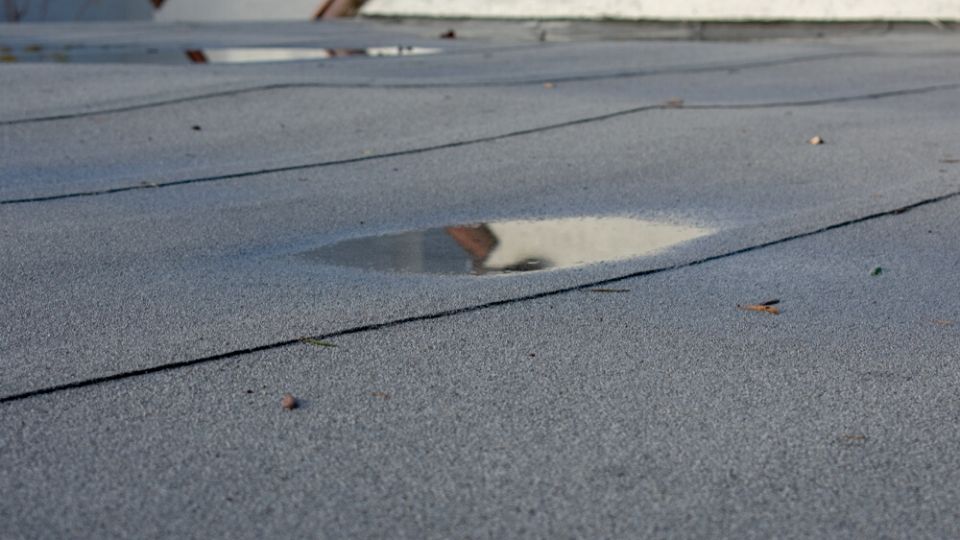
A flat roof is rarely fully flat – that’s why a slope is required to facilitate proper draining. This makes some portions of the roof lower than others and if water collects in these sloped spots – it can damage and deteriorate the roofing material. You’ll notice the issue is there is a pool of water hanging around in the same place for a while.
Collected water can infiltrate the roof structure through these slopes, so you need to look for overlapping circles of dirt to suggest there’s a leakage in that spot. The extent of the problem and damage will indicate if restoration or commercial repair is required.
Collected water can infiltrate the roof structure through these slopes, so you need to look for overlapping circles of dirt to suggest there’s a leakage in that spot. The extent of the problem and damage will indicate if restoration or commercial repair is required.
The Hose Technique
As the last precaution, try spraying water with a hose on flat roof segments you find suspicious. Then, wait for around 10 minutes to notice any signs of water dripping and leakage. This might take hours if the roof is massive, or in case you have no idea where the source of the leakage comes from.
If this is the case, calling a professional in the field of roof waterproofing will be of the essence, in which he will go through more than 5 Ways to Locate and Repair a Leak on a Flat Roof, since no leak – big or small – should be left unattended.
If this is the case, calling a professional in the field of roof waterproofing will be of the essence, in which he will go through more than 5 Ways to Locate and Repair a Leak on a Flat Roof, since no leak – big or small – should be left unattended.